Set States: Kate Mitchell in Conversation
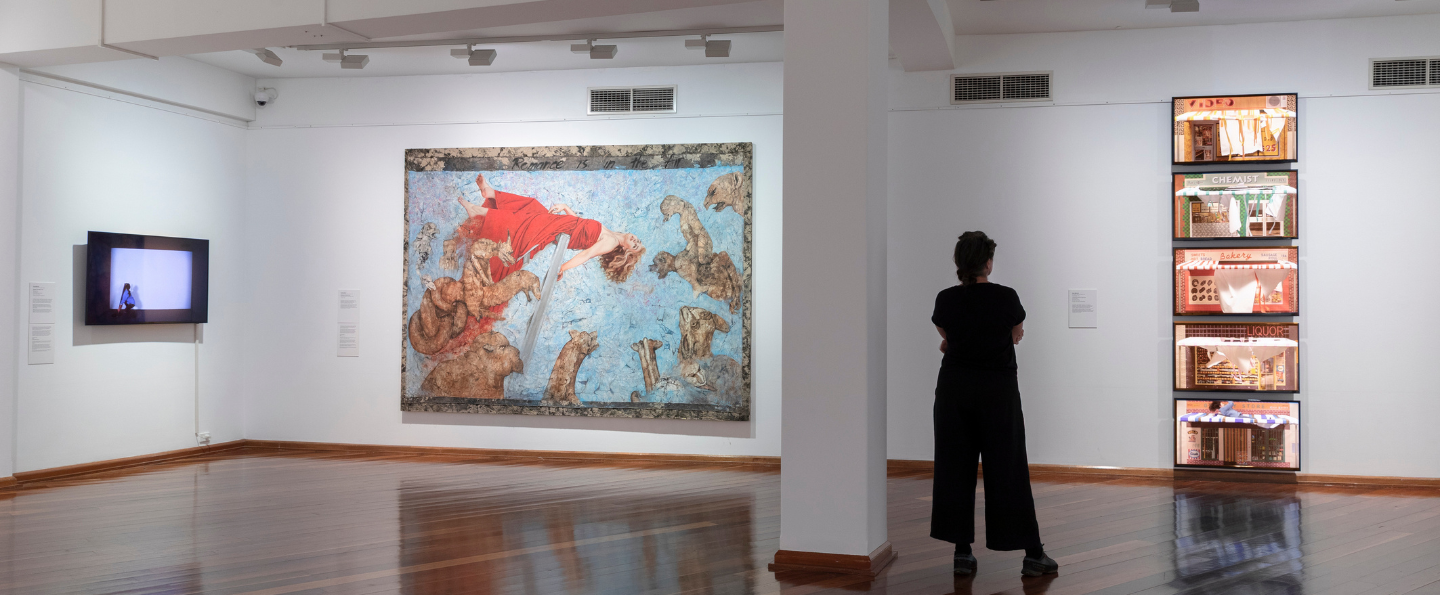
This article draws from a conversation recorded at Wollongong Art Gallery on 20 January 2026 between artist Kate Mitchell, Gallery Director and curator Daniel Mudie Cunningham, and curator Louise Brand, during the presentation of Set States. The exhibition brings together six of Mitchell’s video works — spanning more than a decade — and places them in dialogue with selected works from the Wollongong Art Gallery Collection.
Daniel: The exhibition emerged alongside Mitchell’s major video commission for the Art Gallery of New South Wales (AGNSW), In the Eye of the Giant. That work became the centrepiece of AGNSW’s Hive Festival for 2026, which in turn led to a partnership with Wollongong Art Gallery.
Ahead of developing Set States, we acquired Kate’s Hypnotised Into Being, which became a conceptual anchor for the exhibition. From there, the project evolved through conversation: about humour, bodily risk, consciousness, and the ways these themes reverberate through the collection.
The gallery has been filled with the energy of Hive Festival. Over two days, hundreds of children will have moved through this space, engaging with activities developed in response to Kate’s work. That spirit of play — serious play — feels central to this exhibition.
The following Q&A invites readers deeper into the ideas and shifts underlying Mitchell’s practice, offering insight into how these earlier works continue to resonate within her evolving artistic trajectory.
Your works in Set States span more than a decade. When making these early videos, were you consciously exploring different states of mind or body?
Kate: I think the states I was testing were states of reality — my reality. What is reality? In that first decade of my practice, I was always trying to glimpse what animates everything — the energy behind this magic show of life.
In a way, I felt like a reporter. I would go out into the field, have an experience, and then come back with a report. These works are what those reports look like.
I chose the title Set States because so many of the works from this period begin with building a set. I would decide on a physical action I wanted to explore, then construct the environment for it. I wasn’t interested in post-production — everything needed to exist within the frame. Often the sets were made from paper. I would place myself inside them, set the camera, and record.
Because of that methodology, I usually had only one take. Resetting wasn’t feasible. That created a real relationship between the body, scale and risk. I liked embodying the experience fully — understanding how the body moves, how hair falls, how muscles respond. You can’t fake those things.
If I wanted to fall slowly through everyday life, as in Fall Stack, then I had to physically climb into the ceiling space, shimmy across a pole, and drop onto crash mats. There’s always a moment of fear — what if I bounce off the paper? — but that tension is part of the work.
Watching Fall Stack, you really feel that. There’s joy, but also genuine risk. Your work often uses slapstick and comedy, but it’s never casual. It’s precise and rigorous. Hive’s motto is “play is serious business.” How does humour operate in your practice?
Kate: Humour is a material for me, like acrylic paint. It’s ever-present, and it’s also an attitude to life. I use humour to disarm the viewer. It can bypass the logical thinking mind and slip through the conceptual back door, embedding an idea that might unfold much later.
It’s a covert way of speaking about reality. Slapstick lets you approach things that are actually quite intense or existential, without becoming didactic or heavy.
There’s something about works like Getting Through It, I’m Not A Joke, and Beyond Setting Suns that feels like approaching a void, that existential edge.
Kate: Exactly. Humour allows you to approach subjects you might not otherwise be able to. It creates an opening.
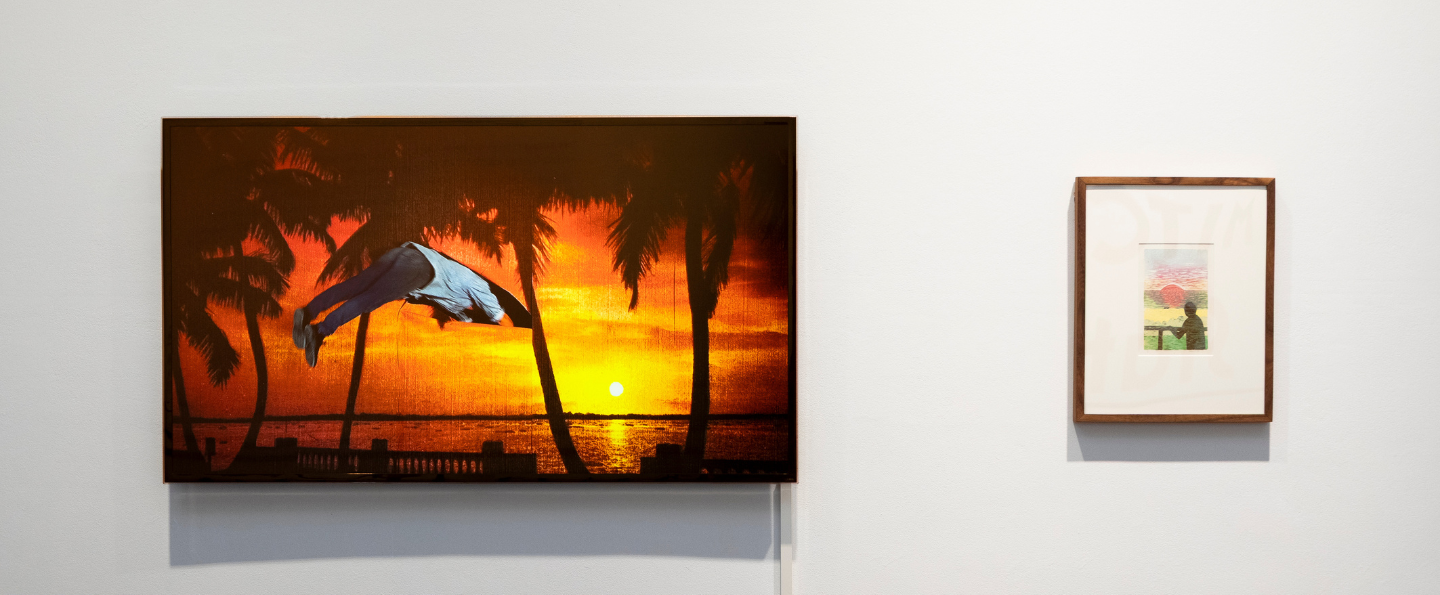
In Hypnotised Into Being, you respond under hypnosis to prompts drawn from art history and art practice. Watching it now, it feels strikingly contemporary — almost like prompt-based authorship. How do you think about agency and intention in that work?
Kate: Hypnotised Into Being was fascinating to make. I worked with a stage hypnotist, and all the prompts related to art or art history. I asked my friend Katherine Brickman to write the list so I wouldn’t know what was coming.
I wanted to know: can I be hypnotised? What does it feel like? And what does the body do when the prompt is an inanimate object — like a paintbrush or a felt-tip pen?
For me, the experience was like being awake inside a dream. I was conscious and aware, and I assumed that if a prompt went against my moral compass I could stop. But with each prompt, my body reacted immediately. It felt as though my movements were drawing on a vast internal archive, a cultural Filodex.
When prompted to become “an art critic,” for example, my body seemed to summon an archetype; shaped by everything I’d absorbed across media and culture. It felt like a strange reflection of society, channelled through movement.
After the two-hour session, driving home, I had a peculiar thought: how else am I being hypnotised? We’re constantly responding to unseen prompts — advertising, routines, systems — without noticing. That realisation stayed with me.
One of the joys of this exhibition has been watching children respond to Hypnotised Into Being almost as a game of charades; mirroring your gestures without needing the art-historical references. That bodily contagion feels important. In Set States, your videos sit alongside works from the collection. How did you experience those pairings?
Kate: I love this premise. You don’t want work to live unseen in storage. Bringing works out of the collection and placing them in unexpected conversations shows how artists across time have grappled with similar questions.
Daniel: Before handing over to Louise Brand, who knows the WAG collection intimately, I should say that I’m still getting to know it myself. In some ways, that sense of discovery is part of the pleasure of an exhibition like Set States. Looking at the collection through a call-and-response framework remains genuinely exciting for me.
There are works and artists I already know well, of course, but there are also moments of immediacy and responsiveness that feel energising within an institutional context. One of the works in this exhibition, an installation by Emma White, entered the collection only weeks before we installed Set States, donated just in time to be included. That kind of responsiveness brings a particular charge.
What I also love about this building is that you’re constantly surrounded by unseen art. There are collection stores on this level; hundreds of works just beyond view. Working with a collection is often about finding the right work to resonate with the narrative of an exhibition.
Louise: I approached the selection intuitively at first. I watched Kate’s videos closely and wrote down whatever associations surfaced, even if they felt slightly left-of-field. I was less interested in illustrating a neat art-historical argument than in allowing affect, humour and material resonance to guide the process.
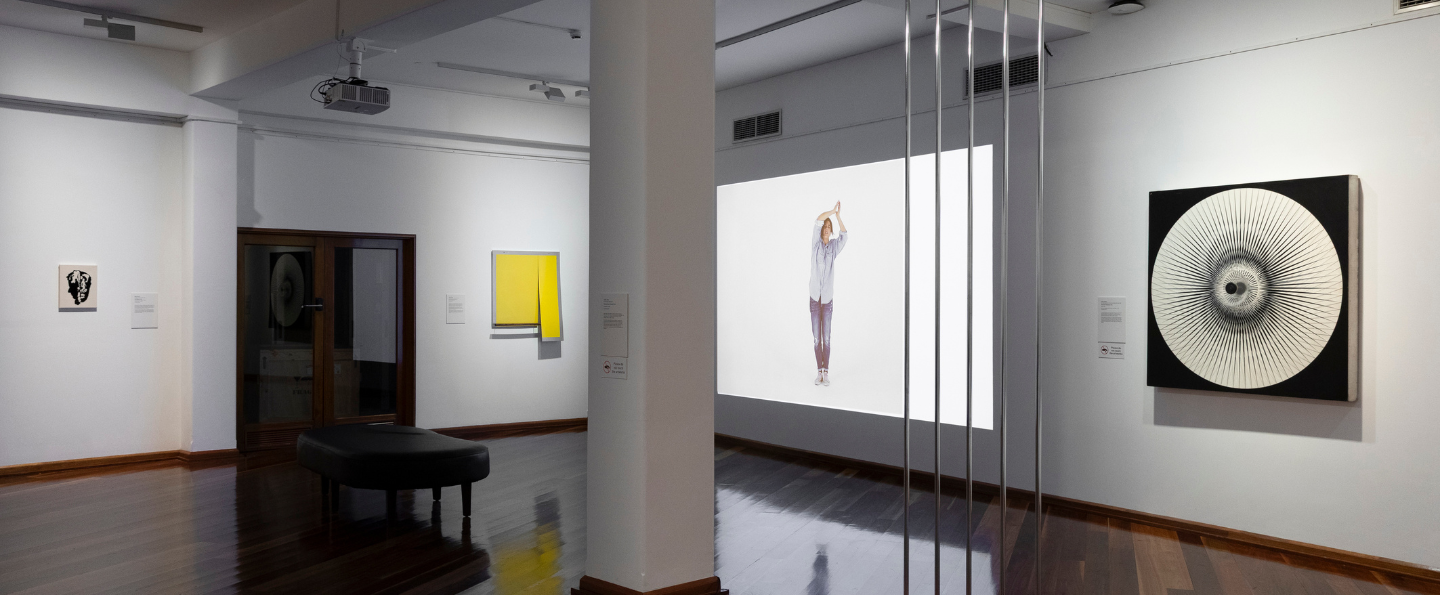
With Hypnotised Into Being, I started thinking about works in the collection that have a hypnotic or optical quality — works you can stand in front of and feel yourself subtly drawn into. That led me to our abstract paintings from the 1960s and ‘70s, including works by artists such as David Aspden and Col Jordan, whose practices were central to Wollongong’s art history and whose works often operate through rhythm, repetition and visual vibration.
I was also thinking about kinetic sensibilities in the collection, including John Fisher’s kinetic sculpture, which informed the way I was thinking about movement and bodily perception in the space. That sense of motion, even when static, felt aligned with the way Kate’s body activates a frame.
From there, Daniel and I began thinking in terms of pairings or small clusters: works speaking across the room rather than illustrating each other directly. For example, Robyn Stacey’s photographic work was placed facing Simon Blau’s painting, creating a visual charge that echoed the performative intensity of Kate’s videos nearby.
In other parts of the exhibition, quieter sculptural works, such as Neil Roberts’ sculpture Things in a state of belonging (1993), sit alongside Kate’s videos about labour, futility and persistence. And with It’s A Sign, I kept thinking about mess, systems, and the desire to tidy or resolve things, which led me to works in the collection that reflect on repetition, work and maintenance.
Even historical works like Helen Eager’s woodcut Beach (1978), with its figure leaning toward the edge of the image, felt suddenly contemporary when placed near Kate’s performances that hover on thresholds or approach limits.
For me, the exhibition feels like a big, eclectic dinner party: different generations, different sensibilities, all unexpectedly in conversation. That’s one of the pleasures of working with a collection; allowing it to speak in new ways.
Kate, finally, looking back at these works from the perspective of your current practice, what feels continuous and what feels transformed?
Kate: I often think about my practice in two volumes: PM and AM. Volume one is PM: pre-Miles. Volume two is AM: after Miles. Becoming a parent to my son Miles fundamentally shifted my relationship to time, to my body, to what I can physically do, to resources, to money, to how I think about making work. It expanded my sense of responsibility and my place in the world, so it was inevitable that the work would change too.
After Miles was born, I had a brief but profound experience driving home from the hospital. My awareness slipped into what I can only describe as a state of oneness. It was momentary, but it felt timeless. In that state there was no separation. Wherever I placed my attention, it was as though I was perceiving through that thing as well as through myself — Miles in the back seat, my partner beside me, a man at a bus stop with his dog, a tree outside the car window — trunk, branches and leaves all at once.
And then, just as suddenly, it zipped back into ordinary reality. But the impact of that experience stayed with me.
With time and reflection, I realised that much of my earlier work. including the videos in Set States, had been oriented toward reaching that state. These works were my field reports: attempts to glimpse something beyond the everyday, to access a sense of interconnectedness through the body.
After that experience, the direction shifted. Rather than trying to get there, I began making work from that place and extending outward. One of the first works to emerge from that shift was All Auras Touch at Carriageworks (2020). That project marked an important transition for me — moving away from testing the limits of my own body in isolation and toward works that think more expansively about shared space, collective experience and energetic exchange.
At its core, my practice now is driven by an interest in making the invisible visible, and in devising projects that speak to the interconnectedness of all things. We live in an ecosystem — an interconnected web — and what we do to that web affects it, whether we are conscious of it or not. The web, in turn, affects us.
That awareness continues to shape how I work, even as the forms change. The projects keep evolving, and I imagine there will be another volume to come.
See Set States at Wollongong Art Gallery until 22 March 2026.
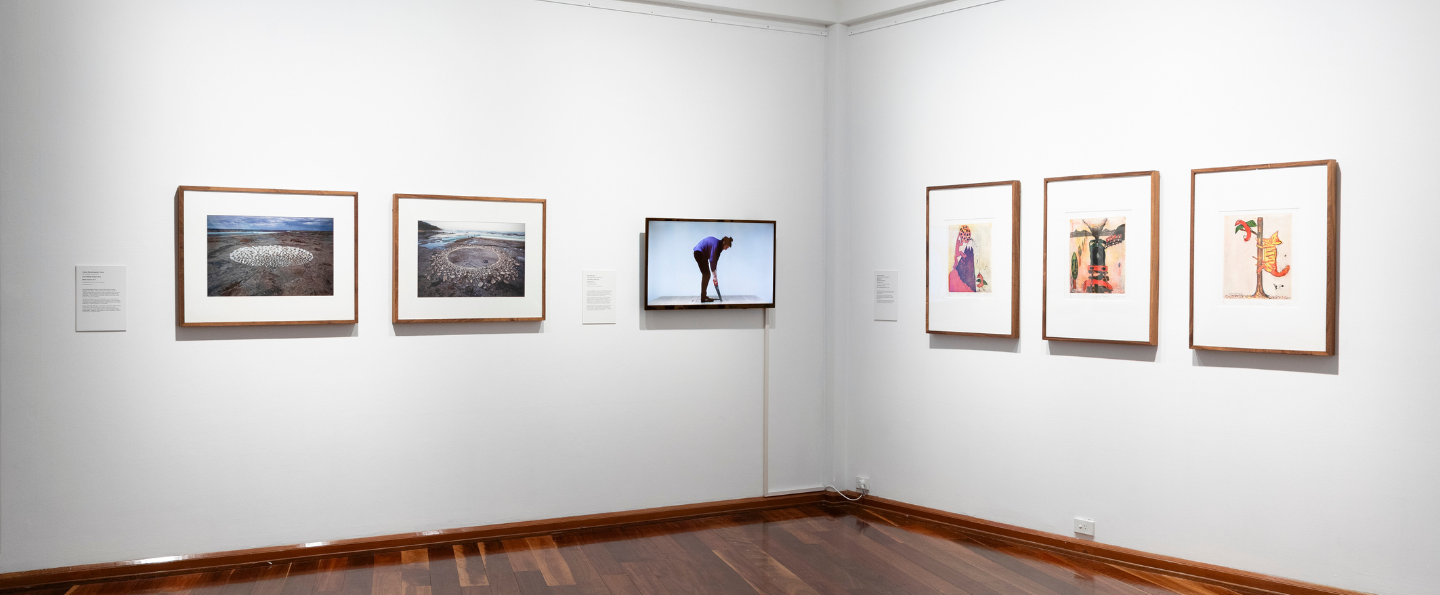
Image: Installation views of Kate Mitchell: Set States with collection works by Annette Bezor, Helen Eager, Sally Smart, Simon Blau, Julian Day, John Fisher, Lizzie Buckmaster Dove, and Graham Fransella. Photos by Silversalt